A night under the Mackenzie sky at Lake Tekapo
Three hours north, into the dark
I drove up from Queenstown in the afternoon, the long way — through Cromwell, past Twizel, with Aoraki sitting flat and pale on the horizon for most of the last hour. It’s about 265 kilometres and just over three hours if you don’t stop, which nobody does, because Lake Pukaki is right there being an impossible colour and you will pull over.
I’d already spent the previous two days doing the loud version of a Queenstown trip — a Kawarau bungy and swing combo one afternoon, a lake trip on the water the next — and this felt like the quiet bookend to that. I wasn’t chasing an aurora. I want to be upfront about that before I say anything else, because half the write-ups about this place promise green light shows that most visitors never see. What I was chasing was just a proper look at the sky, the kind you can’t get from most places I’ve lived.
What the Southern Cross actually looks like
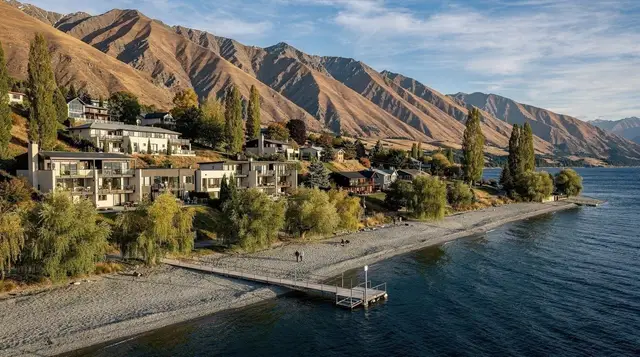
Lake Tekapo sits inside the Aoraki Mackenzie dark sky reserve, one of the largest in the world, and the township keeps its lighting low and amber on purpose. I stood on the lakefront near the Church of the Good Shepherd a bit after ten, once my eyes had properly adjusted — that takes a genuine twenty minutes, not the two most people give it — and the Southern Cross was the first thing I could point to with any confidence.
It’s smaller than I expected, four bright stars in a tight, slightly lopsided kite shape, with a fifth fainter one off to the side that most flags leave out. Next to it, the two Pointer stars sit apart from the pattern, which is how you tell it from the fainter False Cross nearby and avoid pointing at the wrong thing, which I did at least twice.
What struck me more than the Cross itself was the Milky Way running behind it. I’ve stood under genuinely dark skies in the Northern Hemisphere before, and the band there is a soft, even smudge. Here it had structure — darker lanes of dust cutting through brighter clumps, a distinct thickening toward the galactic core that sat low and dense above the hills to the south. That’s the actual difference between hemispheres: from here you’re looking toward the centre of the galaxy for a much longer stretch of the year, and on a clear night in the Mackenzie Basin you can see why astronomers built an observatory on the hill behind me.
The Magellanic Clouds, two smudges that aren’t clouds
Off to one side, away from the main band, were two faint smudges that I’d have dismissed as cloud if I hadn’t known to look for them. These are the Large and Small Magellanic Clouds — not clouds at all, but two dwarf galaxies orbiting our own, roughly 160,000 and 200,000 light years away. They’re visible to the naked eye only from far enough south, which is most of why they carry the name of a European navigator rather than showing up in older Northern astronomy at all.
They don’t look like much on their own account — pale, diffuse patches, easy to miss with any ambient light around — but knowing what you’re actually looking at changes the moment completely. I found the Small Cloud harder to hold onto; it kept disappearing until I looked slightly to the side of it, which is an old trick that actually works because your peripheral vision is more sensitive to faint light.
The cold, and how much it changes things
I’d read the practical guides and dressed for a cold night. I still underestimated it. The Mackenzie Basin is dry and open, with nothing to hold the day’s warmth once the sun drops, and by midnight my hands were the problem, not my patience. If you’re doing this yourself rather than on a guided session that ferries you between warm viewing huts, bring more layers than feels reasonable, a hat, and something hot in a flask.
An hour standing still watching the sky is a different proposition to an hour walking, and the temperature drop after dark here is sharper than most people plan for — worth reading up on if you’re building a wider trip, because Queenstown’s own winter weather behaves the same way and catches people out just as often.
When the moon ruins it
I got lucky with timing rather than planning well — I hadn’t checked the moon phase before I booked the trip, and it happened to be close to new. A local at the church car park told me, unprompted, that I should come back and skip the week either side of full moon, because it washes out almost everything except the brightest stars and planets. I believe her.
The moon is bright enough, and close enough, that even a half-lit night flattens the Milky Way’s structure back into that soft Northern-style smudge and swallows the Magellanic Clouds entirely. If there’s one piece of planning advice I’d pass on ahead of anything about jackets or observatories, it’s this: check the lunar calendar before you check the long-range forecast. Cloud you can sometimes wait out over a couple of nights; a full moon you cannot.
Should you base yourself here, or day-trip it
I stayed the night in Tekapo rather than driving back to Queenstown in the dark, which I’d recommend — the road is fine, but you’ll be tired and it’s a long way to do twice in a day on top of standing outside in the cold for two hours. If you’re building this into a longer South Island run rather than a dedicated trip, it slots naturally alongside a look at Aoraki the next morning, since you’re driving straight past it either way.
If you’d like a calmer daytime counterpart before the long drive north, a paddling session on a quiet alpine lake near Queenstown suits the mood well: still water in the morning, still sky at night, and nothing that needs adrenaline. It also leaves you rested enough to stay awake for the late hours the stars demand.
For anyone weighing whether it’s worth the detour at all against just looking up from Queenstown itself, the honest answer is that the two aren’t really comparable — Queenstown sits in a bowl of hills and its own light, and Tekapo sits inside a reserve built specifically to keep the sky dark.
I’d plan around a good weather window and a thin moon over a specific season; the basin’s own rainfall and cloud patterns matter more than the calendar month you pick. Whatever else is on the things to do list around Lake Tekapo, give this one a full clear night rather than an hour tacked onto a drive-through, because that’s what it actually takes to see any of it properly.
Questions about stargazing at Lake Tekapo
Do you need a tour to go stargazing at Lake Tekapo?
No. The lakefront by the Church of the Good Shepherd is public and free after dark, and on a clear night that’s enough. A guided session at the Mount John observatory gets you a telescope, an astronomer’s commentary, and a warm base between viewings, which matters more than the driving does.
Will I see the aurora australis at Lake Tekapo?
Maybe, but don’t plan around it. Tekapo sits further north than the best aurora latitudes in New Zealand, and even further south the lights need a solar event, a clear horizon, and dark skies to line up. Go for the stars; treat any aurora as a bonus.
What’s the best time of year for stargazing at Lake Tekapo?
Winter nights are longest and driest, but coldest. A new moon in any season beats a clear sky with a full moon. Check the moon phase before you check the weather forecast — it matters more.
How cold does it get at night at Lake Tekapo?
In winter, well below freezing once you’re standing still for an hour. Even in summer the Mackenzie Basin drops sharply after dark because the air is so dry. Dress for a much colder night than the daytime temperature suggests.
Is Lake Tekapo better for stargazing than Queenstown?
Yes, noticeably. Tekapo sits inside a protected dark sky reserve with strict lighting rules across the whole basin, while Queenstown’s own glow and surrounding peaks limit the view. Queenstown is fine for a rough look; Tekapo is where you actually see it properly.
Does the moon really ruin stargazing?
A full moon washes out the fainter stars, the Magellanic Clouds, and the structure in the Milky Way almost completely — you’ll still see planets and the brightest stars, but little else. A thin crescent or no moon at all is what you want.
Stargazing tours in the Mackenzie on GetYourGuide
Verified deep-linked GetYourGuide tours. Book through these links and we earn a small commission at no cost to you.
GetYourGuide does not provide a product photo for this activity — the image shows the meeting point, photographed by us.