Why Queenstown is so expensive
I did the maths on my last trip after a week of wincing at receipts: a burger and a beer near the lake front had cost me more than the same meal in Auckland, a modest room had cost more than a good one in Dunedin, and the bungy jump I’d come for cost roughly what I’d budgeted for two days of food. None of it felt like a rip-off exactly - the burger was good, the room was clean, the jump was the best 8.5 seconds of my trip - but it added up faster than anywhere else I’ve been in New Zealand. So I started asking why, and the answer isn’t one thing. It’s four things stacked on top of each other.
The seasonality is extreme, and it’s doubled up
Most tourist towns have one peak season. Queenstown has two, and they’re opposites. Summer (December to February) brings the lake, the hiking, and the bungy and jet-boat crowds. Winter (June to August) brings skiers to Coronet Peak, The Remarkables and Cardrona. That leaves genuinely quiet shoulder windows only in April and October-ish, and everyone in the hospitality trade knows it.
Accommodation, car hire and even restaurant tables get priced to make the most of roughly seven or eight busy months, because the other four to five have to be survived on thinner margins. I’ve watched the same studio apartment listed at close to double its April rate over the last week of December. That’s not greed exactly - it’s a business trying to cover a slow season using a short one.
If you can move your trip even two or three weeks off the absolute peak, you feel it immediately. I’ve had my best value stays in Queenstown in the first half of April, when Arrowtown is turning gold twenty minutes down the road and the queues for the gondola are a fraction of their January length.
A tourism town of 48,000 people, wearing the traffic of a city
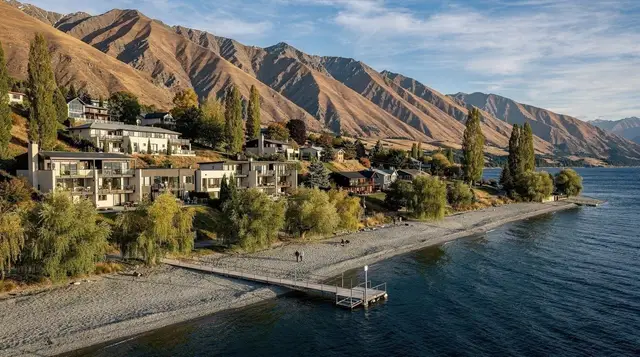
The Queenstown Lakes district has around 48,000 residents. On a busy summer day it’s serving visitor numbers that, in ratio terms, few places in the country come close to. Every bed, seat, rental car and jet-boat slot is competing for the same finite pool of infrastructure that a small town built for itself, not for the world. Land is genuinely scarce here too - the town sits wedged between Lake Wakatipu and steep hills, so there’s no cheap greenfield sprawl to soak up demand the way a flat inland city could. Scarcity plus demand is the oldest price mechanism there is, and Queenstown has both dialled up at once.
Seasonal workers need somewhere to live, and there’s nowhere spare
This is the part visitors don’t see. Queenstown runs on a seasonal workforce - ski instructors, hospitality staff, guides - many on working holiday visas, arriving for a season and needing housing immediately. But the same housing market they’re competing in is the one short-term visitor accommodation has already tightened. I’ve talked to bar staff sharing a three-bedroom house with seven other people because that was what was available near town. Employers increasingly provide accommodation just to be able to staff their businesses at all, and that cost gets built into wages and, eventually, into your bill. A tight labour market for housing doesn’t stay a labour-market problem - it becomes a menu-price problem.
Real estate: holiday homes and short-term lets compete with residents
Queenstown Lakes has some of New Zealand’s highest house prices relative to local incomes, and a real slice of the housing stock functions as a holiday home or a short-term visitor rental rather than a long-term tenancy. That’s a rational choice for an owner chasing summer and winter peak rates, but it means fewer long-term rentals for the people who actually run the town’s cafés, activity desks and hotels. The knock-on is the same loop as the labour point above: less local housing supply pushes up what it costs to keep staff, and that shows up in your dinner bill and your room rate, not in a line item you’d ever see.
What I actually do to spend less here
None of this means Queenstown isn’t worth it - it means I plan around the mechanics instead of pretending they don’t exist.
- Shift the dates. April and October save the most, by a wide margin, on accommodation and car hire.
- Base yourself just outside town. Frankton, Arrowtown and even Wanaka run noticeably cheaper than the CBD and are a short drive or shuttle away. See our Queenstown vs Wanaka comparison if you’re deciding between the two as a base.
- Self-cater some meals. Supermarkets in Frankton are ordinary New Zealand prices; it’s the lakefront restaurants carrying the premium, not the groceries.
- Book big-ticket activities directly and ahead of time, rather than walking into a booking desk on the day when the good time slots are gone and you take what’s left. See our tips for booking tours in Queenstown.
- Pick your splurges, and let everything else be modest. I’d rather have a basic room and spend properly on the one thing I actually came for.
- Use Orbus and shuttles instead of a rental car if you’re staying central and not driving out to Milford or Wanaka - parking and car hire both carry a Queenstown markup.
Where I chose to spend anyway
I didn’t cut the two things I’d actually flown here for. The original commercial bungy jump only exists in one place, and I wasn’t going to skip it to save money - I booked the jump off the Kawarau Bridge, the one Kiwis have been doing since 1988 and don’t regret a cent of it (more on that in I jumped off the Kawarau Bridge).
And rather than pay for a Milford Sound trip solo, I went with a group and split the cost of a full-day trip to Milford Sound for five people, which brought the per-person price down close to a solo cruise-only ticket. If I go back for a bigger adventure day, the full-day canyoning trip into the Routeburn Valley is the one I’ve got my eye on next, saved for when the budget allows it rather than squeezed in against everything else.
Queenstown costs what it costs because of genuine structural pressure - two peak seasons instead of one, a small town absorbing outsized visitor numbers, a workforce competing for scarce housing, and a real estate market pulled toward short-term visitor use. None of that is going to change before your trip. What you can change is when you come, where you sleep, and which few things you decide are worth paying full price for. I’d still go back tomorrow. I’d just go in April, and I’d book the Milford trip as a group again.
For a fuller cost breakdown by category, our Queenstown budget guide walks through daily numbers, and if you’re weighing peak-season dates against shoulder season, our best-time-to-visit guide and the airport transfer options and adventure travel insurance pages are worth reading before you book anything.
tours.Budget travel
Verified deep-linked GetYourGuide tours. Book through these links and we earn a small commission at no cost to you.
GetYourGuide does not provide a product photo for this activity — the image shows the meeting point, photographed by us.