Getting your bearings in Queenstown
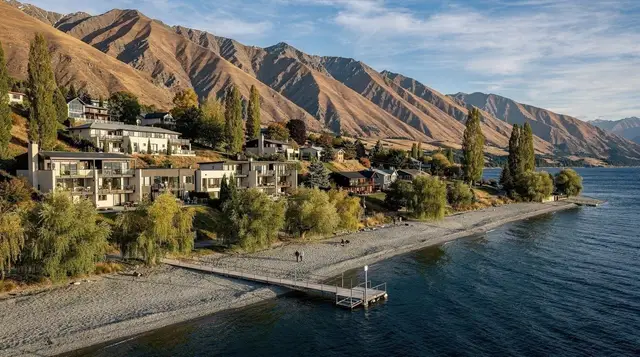
Queenstown is a small town — around 48,000 people across the wider Queenstown Lakes district — wrapped around a bay on Lake Wakatipu, with The Remarkables rising directly across the water. Its Māori name is Tāhuna. The lake itself is unusual: 80 km long, shaped like a lightning bolt, 380 metres deep, and it “breathes” — a seiche raises and lowers the water level by roughly 10 to 25 cm every 26 minutes, which Ngāi Tahu tradition attributes to the heartbeat of the giant Matau sleeping beneath it. It stays around 10°C year-round, which is why most people who go in only go in briefly.
Everything the town is known for sits either in the compact centre or a short drive beyond it, and the two should not be confused when you’re planning a day. The centre — lakefront, Queenstown Gardens, the main shopping streets — is walkable in about ten minutes end to end. Almost everything else in this guide, from the bungy bridges to the wineries to Milford Sound, requires a car, a shuttle or a booked tour. Queenstown sells itself as compact and easy; it’s compact, but it is not a town you can see properly without arranging transport for the surrounding valleys.
Arriving: Queenstown Airport
Queenstown Airport (ZQN) sits at Frankton, about 8 km — roughly 15 minutes — from the town centre. It handles domestic flights from Auckland, Wellington and Christchurch and direct services from Australia. The approach between mountains is considered one of the more technically demanding in the country, the airport runs a curfew, and diversions to Invercargill or Christchurch in poor weather do happen — worth knowing if you’ve booked a tight connection.
From the terminal, the Orbus route 1 runs into town, shared shuttles meet most flights, and taxis are readily available. If you’re renting a car for the wider region, most desks are at or near the terminal; see our notes on getting from the airport into town and on car rental here before you land.
What the town actually sells
Queenstown’s reputation rests on four things, and it’s worth being clear about which is which before you start booking, because each has its own dedicated guide with the real detail — this page is deliberately the overview, not the breakdown.
Adrenaline. Commercial bungy jumping was invented here: AJ Hackett opened the Kawarau Bridge site in November 1988, on a 1880s bridge 43 metres above the Kawarau Gorge, and it still operates today. From that one bridge the town has grown into the country’s densest cluster of jet-boating, canyon swinging, skydiving and white-water rafting operators, most of them running on the Shotover River and the Kawarau. The options, prices and what genuinely differs between them (a 43-metre bridge jump is not the same experience as a 134-metre canyon swing) are covered properly in our bungy jumping guide rather than repeated here.
Wine. Central Otago, the world’s southernmost wine region and New Zealand’s only region with a continental climate, starts a short drive out of town at Gibbston Valley, roughly 25 minutes away. Pinot noir dominates. It’s close enough to visit in an afternoon and is covered in its own guide rather than in detail here.
The lake and the mountain. The gondola up to Bob’s Peak, the TSS Earnslaw steaming across to Walter Peak, and the Skyline luge track above town are the classic half-day activities that don’t require leaving the immediate area — see our separate notes on the gondola and luge and the Earnslaw and Walter Peak crossing.
Fiordland, at a distance. Milford Sound is the single most-asked-about day trip from Queenstown, and it deserves the caveat up front: it’s 288 km and roughly four hours’ drive each way, meaning a coach day trip runs 12 to 13 hours door to door. It’s covered fully in its own guide rather than folded into this one.
a small-group day trip to Milford Sound from Queenstown is one practical way to do that drive without doing the driving yourself, with the Milford Road’s Homer Tunnel and roadside stops handled for you.
What it costs — and why you shouldn’t expect it to be cheap
This is the point worth stating plainly: Queenstown is New Zealand’s most expensive town in high season. It is not a budget mountain town with the occasional splurge activity — accommodation, restaurant meals and organised tours all sit well above national averages from December through March and again through the ski months. A realistic daily budget before tours runs NZD 150–400 per person depending on your accommodation standard, and adventure activities themselves typically add NZD 150–300 each.
Shoulder-season travel in April or from late September to November brings real savings, and self-catering makes a bigger difference here than in most New Zealand towns. Our guides on why Queenstown is so expensive and on doing Queenstown on a budget go into where the money actually goes and where it can be trimmed.
None of this is a reason to avoid it — it’s a reason to budget honestly and to book weather-dependent activities (skydiving, scenic flights, Milford cruises, heli-hikes) early in your stay with a spare day in reserve, since cancellations for weather are routine, not exceptional.
Where to stay and how the town is laid out
Queenstown doesn’t really have distinct “neighbourhoods” in the way a city does — it’s a lakefront centre with a handful of surrounding pockets, each suited to a different kind of trip. Staying right in the centre puts you within walking distance of the lakefront, Queenstown Gardens and the restaurant strip, at the highest prices. Fernhill and Sunshine Bay, a short walk or drive further round the lake, trade a little distance for quieter and often cheaper accommodation.
Frankton and the area near the airport suit anyone prioritising an early flight or a rental car over lake views. Basing yourself in Arrowtown, 20 minutes out, is a genuine option too — it’s quieter, has its own gold-rush-era character, and puts you closer to Gibbston wine country, at the cost of a short drive into Queenstown itself for restaurants and activities. The full comparison, with what each option actually costs, is in where to stay in Queenstown.
Day trips and excursions from town
Once you’re settled, Queenstown works as the launch point for a wide radius, and the right side trip depends heavily on how many days you have. Glenorchy, 46 km and about 45 minutes along one of the country’s more scenic drives, gives lake and mountain scenery with almost none of the town’s crowds. Arrowtown covers gold-rush history in an afternoon. Milford Sound, as above, needs a full day at minimum and ideally an overnight in Te Anau.
Central Otago’s wineries around Gibbston and, further out, Cromwell and Bannockburn, fill a relaxed half or full day. For a fuller list matched to how much time you actually have, see the best day trips from Queenstown and, if you’re still working out your overall trip length, how many days you need in Queenstown — a straightforward three-day itinerary is a reasonable starting template if you’d rather not build one from scratch.
Adventure activities worth building a day around include a bungy or canyon swing combination — a Nevis Bungy and Swing combo out in the canyon — river rafting on the Kawarau, which is more accessible than the Shotover’s grade III–IV water — a Kawarau River white-water rafting trip — or a scenic option that pairs Central Otago’s vineyards with the view from above — a helicopter wine-sampler tour over Central Otago.
Eating in town
Fergburger, open since 1994, is the fixture everyone mentions and the queue is real — plan for it rather than being surprised by it, and note that Fergbaker and Mrs Ferg sit right alongside it if the wait is too long. Beyond the burger queue, the lakefront strip covers most price points, and the wider food scene leans on high-country produce — lamb, venison and salmon from the Mackenzie canals — alongside a growing number of craft breweries and gin distilleries. Tipping isn’t customary in New Zealand. For a proper rundown of where to actually eat rather than where the queue is longest, see Queenstown’s restaurants and food scene.
Booking tours without wasting a day
Because so much of what Queenstown sells is weather-dependent — skydiving, scenic flights, Milford cruises, jet-boating in heavy rain — it’s worth booking flexible activities early in your stay rather than on your last available day, and checking each operator’s rescheduling policy before you pay. Our tips on booking tours in Queenstown cover what to check before committing. If you’d rather not organise your own transport for Milford Sound, cruises depart daily and can be combined with the drive or with a scenic flight back — a guided river sledging trip on the Kawarau is one of the more approachable water-based options if bungy and canyon swinging aren’t for you.
Pacing your days so the town works for you
The most common mistake visitors make is treating Queenstown as a checklist. The town rewards a looser rhythm: one big commitment per day, whether that is a river trip, a valley drive or a long cruise, with the rest of the day left for the lakefront, a slow lunch or an hour on the water’s edge. Days that stack three bookings back to back tend to be the ones people remember for the logistics rather than the scenery.
A useful way to plan is to separate the weather-dependent bookings from the flexible ones. Anything that needs clear skies goes early, with a spare day behind it. Wine tasting, Arrowtown, the gondola and a walk through Queenstown Gardens can all be moved around without much loss, so they make good fillers when the cloud comes down. If the forecast turns, our notes on Queenstown on a rainy day list what still works indoors and under cover.
Who the town suits, and who it doesn’t
Couples and friends who want scenery, good food and the option of an adrenaline hit sit squarely in the town’s sweet spot. Families do well too, because there is plenty that isn’t extreme — see Queenstown with kids for how to choose. Walkers can use the town as a base for a day on the trails; start with the best hikes around Queenstown and the Routeburn Track guide if a longer walk is on your list.
It suits travellers on a tight budget less well, and anyone looking for quiet, undeveloped country will find the centre busy in season. That isn’t a criticism so much as a description: the town is built around visitors, and the quiet places are the ones you drive or fly to from it. If you’re new to the country and want a gentler introduction, the first-time guide to Queenstown pulls the essentials into one place.
Scenery worth stopping for
You don’t need to book anything to enjoy much of what makes the place famous. The lake shore at the edge of town, the view across to The Remarkables and the drive out towards Glenorchy all reward unhurried stops. For the best vantage points and the light that suits them, see photography spots in Queenstown. Film fans will also find that the surrounding valleys doubled for Middle-earth, which is covered in Lord of the Rings locations around Queenstown.
When to visit
Summer, December to February, gives up to around 21.5 hours of daylight at the solstice, temperatures of 20–30°C, and every operator running — along with peak prices and an unusually high UV index, so sun protection matters more here than the temperature alone suggests. Autumn, March to May, brings Arrowtown’s poplar and larch colour in April, clearer air and a noticeable drop in both crowds and cost. Winter, June to August, is ski season at Coronet Peak, The Remarkables, Cardrona and Treble Cone, with around nine hours of daylight and regular frosts.
Spring, September to November, is the least predictable — snowmelt, unsettled weather, and the invasive lupins that colour the Mackenzie basin roadsides from late November. Rainfall varies enormously across the wider region: Queenstown itself gets around 900 mm a year, while Milford Sound gets close to ten times that — never assume one figure describes the whole area. Full month-by-month detail is in our Queenstown weather guide, and separate breakdowns exist for Queenstown in winter and Queenstown in summer if you’re deciding between them.
Before you commit to the dates
Queenstown is easy to arrive in and hard to leave on schedule, since weather, flights and road conditions all feed into each other. Build a margin into the end of your stay, especially if an onward flight is tight, and keep your accommodation and activity bookings as flexible as you can. Travellers coming from overseas should also check entry requirements early; our guide to NZeTA and entry requirements explains what to sort out before you fly. A little slack in the plan costs very little here and saves a great deal of stress.
Queenstown, in short
Queenstown is not a cheap alpine village to pass through — it’s a small, tourism-built town that has spent decades becoming the country’s centre for bungy jumping, jet-boating, canyon swinging and lake cruising, with Central Otago’s wineries next door and Milford Sound a long but manageable day away. It rewards travellers who come with a plan and a realistic budget, and it’s frustrating for anyone expecting bargain prices or a walkable-everything town. Treat this page as the map; the linked guides above are where the actual planning happens.