Why you can’t just drive there
Walter Peak High Country Farm sits directly across the water from central Queenstown, close enough that you can see its farm buildings from the town waterfront on a clear day. That closeness trips people up. Looking at a map, it seems obvious to hire a car and drive around. There is no road that gets a visitor there.
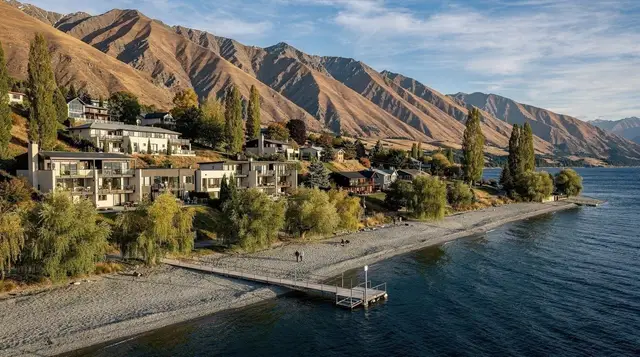
The station sits on the western shore of Lake Wakatipu, backed by mountains and cut off from the Queenstown side by the lake itself. Farm vehicles use a long, unsealed back-country route that loops around via the head of the lake, but it isn’t set up for tourist traffic, isn’t signposted for it, and isn’t part of any visit product sold to the public. For everyone who isn’t staff or stock truck, the only way in is across the water.
That’s not a downside so much as the point of the place. A short cruise is baked into every Walter Peak visit, and for most people that cruise is the reason to go at all.
The TSS Earnslaw crossing
Almost every Walter Peak trip travels aboard the TSS Earnslaw, a twin-screw steamship launched in 1912 that still burns coal in its original boilers. It’s one of the oldest working coal-fired passenger vessels left in the southern hemisphere, and it has carried passengers across Wakatipu for well over a century without a break in service. The crossing to Walter Peak takes around an hour each way, past Cecil Peak and Walter Peak itself, with the Remarkables receding behind you and Queenstown shrinking to a strip of buildings under Bob’s Peak.
You can go up on deck for the views or head below to watch the engine room, where the original steam machinery is visible through glass and a crew member usually explains how it works. It’s slow travel by design — nobody is trying to get you to Walter Peak quickly, they’re selling the crossing as part of the day. On a still morning the lake is glassy; in wind it’s genuinely choppy, and this is the main reason sailings are occasionally cancelled or delayed. Check the operator’s status if the forecast looks rough rather than assuming the boat will run on schedule.
A smaller, faster catamaran also runs the route on some itineraries, mainly for evening dinner cruises, but the TSS Earnslaw is the vessel almost everyone pictures and almost everyone gets.
What’s actually at the farm
Walter Peak Station has been run as a working high country farm since the 1860s, one of the oldest pastoral leases in the district, and the visitor operation is built around a working demonstration rather than a static museum. Three things anchor the standard visit.
The shearing demonstration. A shearer works through a merino or perendale sheep by hand in a small shearing shed, explaining the process as they go — how the fleece comes off in one piece, why the sheep don’t seem to mind, what happens to the wool afterwards. It runs on a schedule tied to cruise arrivals, so if you’re on the standard package you’ll see it without needing to plan around it.
The sheepdogs. A handler runs huntaway and heading dogs through a paddock demonstration, moving sheep on whistle and voice commands. Huntaways bark and push from behind; heading dogs work silently out in front to block and turn the mob. It’s a genuine skill demonstration, not a trick show, and it’s usually the part people remember longest.
Meeting the animals. Beyond the sheep and dogs, the farm keeps highland cattle, deer, alpacas and other paddock animals near the visitor area, and there’s usually a chance to pat lambs in season. It’s low-key rather than a petting zoo, which suits the working-farm framing the whole visit goes for.
The Colonel’s Homestead
Lunch, when it’s included, is served at the Colonel’s Homestead, a restaurant building on the property styled around the farm’s high country heritage — timber interiors, an open fire, and views back across the lake to the Remarkables and Cecil Peak. The format is a buffet-style barbecue: lamb, venison and other high country meats grilled and served alongside salads and sides, with a colonial-farmhouse feel rather than fine dining. It’s the same building used for the evening dinner cruise option, lit differently and served differently after dark.
It won’t be the best meal of your trip — it’s catering for cruise-load numbers on a schedule — but it’s a reasonable and filling stop, and for many visitors it’s the only reason to extend a Walter Peak visit past the two-hour minimum.
Horse trekking
Walter Peak also runs guided horse treks along the lakeshore and farm trails, aimed at beginners and suited to riders who’ve never been on a horse before as much as experienced ones. Treks run as a separate add-on with their own timing, generally requiring a longer stay on the property than the standard cruise-and-farm-show loop, so they need to be booked as part of a specific package rather than added on the day. If riding is the main draw for you, check which sailing times connect to the trek slots before booking — not every crossing lines up with every ride.
Choosing a visit format
| Format | Roughly includes | Length | Suits |
|---|---|---|---|
| Cruise and farm show | TSS Earnslaw return crossing, shearing demo, sheepdog demo | ~3.5 hours | First-time visitors, tight schedules |
| Cruise, farm show and BBQ lunch | The above plus buffet lunch at the Colonel’s Homestead | ~4 hours | Anyone wanting a full midday outing |
| Evening dinner cruise | Crossing plus buffet dinner at the Colonel’s Homestead | ~3–4 hours | Couples, a change from Queenstown’s restaurants |
| Cruise, farm show and horse trek | The above plus a guided trail ride | Half day or more | Riders, families with older kids |
Prices vary by season and operator package, so treat the day-budget figure above as a planning range rather than a quote, and check current listings before you commit a day to it.
When to go and what to expect
Walter Peak runs year-round, and the farm show itself doesn’t change much with the seasons — sheep get shorn, dogs work paddocks, and the boat crosses the lake whatever the month. What changes is the weather on the water and the light. Summer crossings are calm and warm on deck; winter ones are colder, and the surrounding peaks often carry snow down toward the shoreline, which makes for a better photograph than a July swim would. Wind is the real variable: Wakatipu can turn choppy quickly, and that’s the most common reason a sailing gets delayed or cancelled rather than run as scheduled. Bring a layer regardless of season — it’s noticeably cooler on the water and on the exposed farm paddocks than it is in central Queenstown.
Because the whole visit runs on a boat schedule, it isn’t a spontaneous stop. Departures leave from the Queenstown waterfront at set times through the day, and you need to be back at the wharf for your return sailing rather than lingering. If you’re short on time in Queenstown, this is one of the easier half-days to slot into a two-day itinerary precisely because it has a fixed, predictable length — unlike a Milford Sound day trip, which can run to thirteen hours door to door.
Getting the booking right
Walter Peak sells as a packaged product — crossing, farm show and any add-ons bundled into one ticket — rather than a pay-as-you-go stop, so it pays to check exactly what’s included before paying: some packages cover lunch, others don’t, and horse trek slots don’t run on every departure. If you’re building a longer Queenstown stay around Wakatipu itself, pair it with a look at Lake Wakatipu cruises more broadly, or read up on the Earnslaw’s history before you board — knowing you’re on a working 1912 coal-fired steamer changes how you look at the engine room.
Families travelling with kids generally find it an easy win: the shearing and sheepdog shows are short enough to hold attention, and there’s space to move around outside rather than sitting still, which our broader Queenstown with kids guide covers alongside other easy half-days. On a wet morning, it’s also a reasonable rainy-day option — the shearing shed and homestead are under cover, even if the paddock demonstrations get muddier.
If horses aren’t your interest but you want more of the district’s working-farm and back-country character, Glenorchy and the head of the lake offer a different, road-accessible version of the same high country landscape, while Arrowtown gives you the gold-mining side of Otago’s history rather than the pastoral one. Together they round out a fuller picture of what’s around Queenstown beyond the adrenaline activities the town is best known for.
Making a full day of it
Walter Peak itself runs to a fixed half-day, which leaves room to add a second activity either side of it if you’re only in Queenstown briefly. Flightseeing is the obvious pairing, since both run on weather-dependent schedules that are best locked in early in your stay rather than left to the last day. A scenic flight over Milford Sound fits neatly into an afternoon after a morning at Walter Peak, or you can combine flying with a cruise on the fjord itself on a fly-cruise-fly day trip to Milford Sound if you want both landscapes in one day without the four-hour drive each way.
For a change of pace that still fits a half-day slot, the glowworm caves tour at Te Anau makes a good contrast to Walter Peak’s open farmland — underground and quiet where the farm is outdoors and hands-on. If you’re chasing something with more of an adrenaline hit to balance out an otherwise gentle farm visit, a tandem skydive over Wanaka is a straightforward add for the following day.
However you build the day around it, keep Walter Peak itself simple: book the crossing and show, decide on lunch or a horse trek in advance, and don’t plan anything else tightly against the return sailing time.
Walter Peak High Country Farm: questions before you go
Can you drive to Walter Peak?
No. There’s no public road a visitor can use to reach the farm from Queenstown or anywhere else on the eastern side of the lake. The only practical access is by boat, almost always the TSS Earnslaw from the Queenstown waterfront.
How long does the boat crossing take?
Around 60 minutes each way on the TSS Earnslaw, so roughly two hours are spent on the water alone before you count time on the farm itself.
Is the TSS Earnslaw really coal-fired?
Yes. It was launched in 1912 and its original boilers still burn coal, making it one of the oldest working coal-fired passenger vessels operating in the southern hemisphere.
What does the standard visit include?
The core package covers the return crossing, a shearing demonstration and a sheepdog working demonstration, running to about 3.5 hours door to door. Lunch, dinner and horse trekking are separate add-ons on longer packages.
Is Walter Peak suitable for young kids?
Generally yes. The shearing shed and sheepdog paddock are short, visual demonstrations that hold children’s attention well, and there’s space to move around rather than sit still for long stretches.
Can sailings be cancelled?
Occasionally, yes. Lake Wakatipu can turn choppy in wind, and that’s the most common reason a crossing is delayed or cancelled rather than run to schedule. Build in some flexibility if Walter Peak is the only activity planned for that day.
Do you need to book the horse trek separately?
Yes. Horse treks run on their own schedule and don’t connect to every crossing, so they need to be booked as part of a specific combined package rather than added once you’re on the farm.
Is there anywhere to eat if I don’t book the lunch package?
Food service on the farm is tied to the buffet lunch and dinner packages at the Colonel’s Homestead; there isn’t a casual café for drop-in visitors, so eat before you leave Queenstown if you haven’t booked a meal.