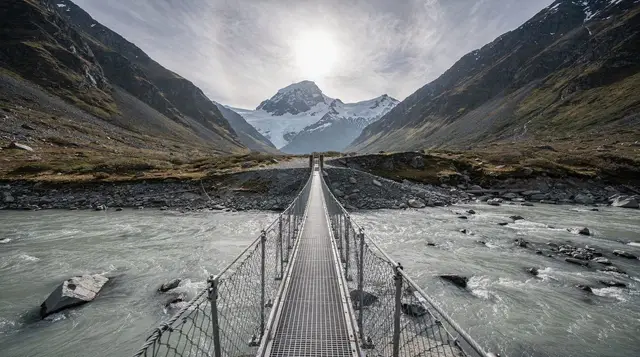
Paradise is not a resort and not a town. It is a scattered rural locality of farmland, beech forest and mountain flats about 20 km past the end of the sealed road at Glenorchy, at the head of Lake Wakatipu. There is no shop, no fuel and, for most of the drive in, no phone signal.
What there is: a stand of silver beech forest that stood in for part of Lothlórien, river flats used for exterior work tied to Isengard and the Fellowship’s journey near Amon Hen, and the trailheads for the Dart River and the Routeburn Track. It rewards the visitor who plans the drive properly and disappoints the one who treats it like an extension of the Glenorchy car park.
Getting to Paradise: the drive and its limits
The trip has two distinct stages, and they should be planned as two separate decisions rather than one continuous drive.
The first stage is Queenstown to Glenorchy: 46 km of sealed, well-maintained road along the western shore of Lake Wakatipu, roughly 45 minutes without stops. This section suits any rental car and is one of the more scenic short drives in the region in its own right, with the lake on one side and the Richardson and Humboldt ranges on the other.
The second stage is Glenorchy to Paradise: about 20 km further on an unsealed road that crosses several fords. In dry, settled conditions this adds 20 to 30 minutes and is manageable in a well-driven 4WD with reasonable clearance. After rain, the calculation changes. The fords draw from catchments in the surrounding mountains and can rise within an hour of heavy rain higher up the valley, long before it looks like much is happening at road level. A ford that was a trickle over the wheel rims in the morning can be a genuine hazard by afternoon.
This is also the section most rental agreements exclude by name, alongside Skippers Canyon and Macetown elsewhere in the region. Read the fine print before assuming a 4WD badge on the vehicle means the contract allows the road. If it does not, or if the fords are running high, book a guided tour instead: operators based in Glenorchy and Queenstown run the road daily in vehicles built for it, and drivers who know the current ford levels are worth the fee on a day when the water is up. See driving in New Zealand’s South Island and car rental in Queenstown for what local contracts typically exclude, and check current advice before committing to a self-drive.
| Option | Suits | Rough cost |
|---|---|---|
| Self-drive, own suitable 4WD | Confident drivers, dry conditions, flexible schedule | Fuel only |
| Guided 4WD tour from Glenorchy or Queenstown | Anyone without a cleared vehicle, or after rain | NZD 150–250 per person |
| Helicopter or scenic flight over the valley | Time-poor visitors, photographers, poor ground access days | NZD 250–600 per person |
The name, the forest and the film locations
Nobody can point to a single certain origin for the name Paradise. Locally it is put down either to early runholders naming the flats for their beauty, or to the pūtangitangi (paradise ducks) once common on the river flats — both explanations circulate and neither is settled fact, so treat it as local colour rather than history.
What is not in dispute is the look of the place. The silver beech forest along the road, with moss-floored light filtering through the canopy, was used for sections of Lothlórien, the Elven forest of The Lord of the Rings. The open river flats nearby carried exterior work connected to Isengard, and the wider valley contributed to scenes near Amon Hen. None of it is signposted — there is no gate, plaque or gift shop marking a single frame — which is either part of the appeal or a source of mild disappointment depending on how much research was done beforehand.
Two ways to find the actual spots: a guided Lord of the Rings tour that already knows which bend in the road or gap in the trees was used, or a self-drive guide with GPS points and photo references done in advance.
See Glenorchy Middle-earth tours for the guided option and a Lord of the Rings self-drive itinerary for doing it independently; Lord of the Rings locations around Queenstown covers the wider set of sites beyond Paradise, since several other locations sit closer to town and require no unsealed driving at all. For the broader category, things to do themed around Lord of the Rings lists tours and self-guided options together.
Worth being upfront about: the forest and flats are attractive on their own terms, film history or not. A visitor expecting an obvious “movie set” feel, with recognisable structures or dressed scenery, will not find one. What remains is bare landscape doing the work the cameras once used it for.
Into the Dart Valley
Paradise sits at the practical gateway to the Dart Valley, the glacially carved system that runs north toward Mount Aspiring and forms one side of the Routeburn-Dart tramping circuit. Several walks start from around Paradise itself, ranging from short loops through the beech forest and along the river braids to full-day options for fitter walkers, without committing to the multi-day Routeburn or Dart-Rees tracks.
For those with more time, the trailheads here connect to the Routeburn Track, one of the region’s Great Walks, and to the longer Dart and Rees valley routes favoured by trampers wanting a quieter alternative to the Routeburn’s higher visitor numbers.
Neither should be started casually from a day-trip mindset: both require proper preparation, correct footwear and an honest read of the weather, which changes quickly in this part of the Southern Alps. See the Routeburn Track guide, Great Walks near Queenstown and the best hikes around Queenstown for what each route actually demands before committing.
Kea are present in this part of the alpine backcountry — the world’s only alpine parrot, intelligent, endangered and best left entirely alone. Feeding one, deliberately or by leaving food unattended, does it no favours and is not something any operator or guide in the area will encourage.
Fords, weather and the mistake to avoid
The single most useful piece of advice for Paradise is also the simplest: the road is not a fixed quantity. It changes with the weather, sometimes within hours, and treating a morning ford crossing as proof the same crossing will be fine on the return trip in the afternoon is the mistake that catches people out. Rain higher in the Dart and Rees catchments raises river levels at Paradise well before it is obviously raining at the road.
Practical rules that hold up: check a forecast for the whole catchment, not just Glenorchy or Queenstown, before setting out. If a ford looks fast, opaque or deeper than expected, do not guess — turn around and wait, or come back another day. Vehicles get stuck or swept sideways in fords that looked crossable a moment before someone tried them, and a guided tour’s local knowledge of which crossing is currently safe is worth more than confidence in a rental 4WD’s ground clearance.
There is no fuel past Glenorchy and phone signal disappears well before Paradise, so this is not a place to run low on either. Carry more water and food than the trip seems to need, and if walking beyond the road, tell someone the plan and the expected return time.
Where Paradise fits in a Queenstown day or trip
Paradise works best as a half-day extension to a Glenorchy visit rather than a destination booked on its own from Queenstown, unless the trip is specifically built around the Dart Valley or Lord of the Rings locations. A realistic day covers Queenstown to Glenorchy, lunch or a coffee in Glenorchy, then the run out to Paradise and back, with time for a short forest walk. Add the Routeburn or Dart trailheads and the day becomes considerably longer.
For visitors without a suitable vehicle, without time for the unsealed drive, or simply keen to see the valley from a different angle, a helicopter flight over Glenorchy and the head of the lake covers the Dart’s braided river flats and the surrounding peaks from the air, with the option to continue on to a scenic cruise combined with the flight over Milford Sound.
A shorter alternative pairs the same alpine scenery with a look at the West Coast beaches on a 75-minute helicopter tour taking in Milford Sound and the coast, while a fixed-wing option keeps costs a little lower on a scenic flight over Milford Sound and the Fiordland peaks. None of these fly specifically to Paradise, but all cross the same mountain and glacial-valley country the road drive reaches at ground level, which is a reasonable trade for anyone short on time or wary of the fords.
Anyone drawn to Paradise for its water and mountain combination but unable to make the drive at all has a less direct but still relevant option closer to town: a guided kayak tour on Lake Wanaka covers comparable glacially carved scenery without the unsealed road or the ford risk, and suits travellers based around Wanaka rather than Glenorchy.
Fit Paradise into a wider plan with how many days to spend in Queenstown, the best time to visit Queenstown for matching the trip to a season with reliable fords, tips for booking tours in Queenstown, and the wider list of best day trips from Queenstown for comparing Paradise against the region’s other options before settling on an itinerary.
What to bring and what to skip
Bring more fuel margin than the trip appears to need, a paper map or an offline map on a phone, since signal drops out well before Paradise, and proper footwear if any of the forest or river walks are on the plan. A raincoat earns its place even on a clear morning, given how fast weather turns in the Dart catchment.
Skip the idea of a quick look on the way to somewhere else. Paradise is a deliberate detour with a genuine access constraint, not a drive-by stop, and the reward is proportional to treating it that way: allow the time, respect the fords, and the beech forest and mountain flats that stood in for Middle-earth are there without a queue, a gate or a gift shop in sight.
Questions about visiting Paradise
How do you get to Paradise from Queenstown?
Drive to Glenorchy first, 46 km on a sealed road that takes about 45 minutes. From there it is another 20 km on unsealed road with several fords to Paradise itself, adding 20 to 30 minutes in good conditions and more after rain.
Can you drive to Paradise in a standard rental car?
Most rental agreements exclude this road outright, and the fords make it unsuitable for a low-clearance two-wheel-drive car in any case. A high-clearance 4WD, a rented vehicle cleared for the route, or a guided tour from Glenorchy or Queenstown is the realistic option.
What was filmed at Paradise for The Lord of the Rings?
The beech forest here stood in for parts of Lothlórien, and the surrounding flats and river were used for exterior work associated with Isengard and the Fellowship’s journey near Amon Hen. None of the sites carry signage, so a guide or a self-drive guide is useful for finding the right spots.
Are the fords on the road to Paradise dangerous?
They can rise quickly after rain in the Dart catchment, sometimes within an hour, and a ford that was ankle-deep in the morning can be impassable by afternoon. Do not attempt a crossing if the water is fast-moving or you cannot see the bottom, and turn back rather than guess.
Is there fuel, food or phone signal at Paradise?
None. The last fuel and the last shop are in Glenorchy, and mobile coverage drops out well before Paradise. Fill the tank, carry water and snacks, and tell someone your plan if you are walking further into the valley.
What is the difference between Paradise and Glenorchy?
Glenorchy is a small township with basic services at the head of Lake Wakatipu, and the sealed road ends there. Paradise is a scattered rural locality another 20 km on, with no shops, services or settlement to speak of beyond farmland, forest and the trailheads into the Dart Valley.
Can you walk from Paradise into the Dart Valley or the Routeburn Track?
Yes. Paradise sits close to trailheads for the Routeburn Track and the Dart Valley and Rees-Dart routes, and shorter forest and river walks near the road are open to casual visitors without a multi-day commitment.
When is the best time to visit Paradise?
November to April gives the most reliable fords and the best light in the beech forest, with autumn adding colour from the deciduous trees around Glenorchy on the way in. Winter is possible but the road can ice over and the fords run higher and colder.