Bungy jumping in Queenstown: the complete guide
Which Queenstown bungy jump should I book?
Kawarau Bridge (43 m) is the original 1988 site and the most approachable, with an optional dip in the river. The Ledge (47 m, from Bob's Peak) suits anyone who wants a running or backwards jump close to town. Nevis Bungy (134 m, 8.5 seconds of free fall) is the serious one, out in a canyon 45 minutes from Queenstown by 4x4.
Queenstown didn’t just add bungy jumping to its list of things to do — it invented the commercial version of the sport. AJ Hackett opened the Kawarau Bridge site in November 1988, on a road bridge built in 1880, and it’s still running today, in the same gorge, off the same style of platform. Everything else in the world’s bungy industry traces back to that bridge.
This guide covers the three jumps you can do from a Queenstown base — Kawarau Bridge, The Ledge and Nevis Bungy — what actually differs between them beyond the number on the brochure, who can and can’t jump, and the insurance question that catches out more travellers than the jump itself does.
Why Queenstown is the home of commercial bungy
Bungy jumping existed before 1988, tied to vine-jumping traditions and a handful of stunt jumps off bridges and towers elsewhere in the world. What AJ Hackett did at the Kawarau Bridge was turn it into something you could simply turn up and pay for, with trained staff, checked equipment and a fixed site — the first of its kind anywhere. The bridge itself dates to 1880 and sits over the Kawarau River in the Kawarau Gorge, about 25 minutes from central Queenstown, in the same valley as the Gibbston wine district.
That original site is now one of three operating around Queenstown, each with a genuinely different feel rather than just a different number attached to it.
The three jumps, compared
| Jump | Height | Free fall | Where | Character |
|---|---|---|---|---|
| Kawarau Bridge | 43 m | Several seconds | Kawarau Gorge, ~25 min from town | The original 1988 site; static platform, optional water touch |
| The Ledge | 47 m | Several seconds | Bob’s Peak, above Queenstown | Running or backwards jump, 400 m of air below, night jumps available |
| Nevis Bungy | 134 m | 8.5 seconds | Nevis Canyon, ~45 min by 4x4 | New Zealand’s highest bungy, jump from a suspended pod |
None of these numbers alone tells you which one to book. Kawarau is the most approachable because the platform sits close to the water and the operation moves at a steady pace; it’s also the only one of the three where you can ask for a dip in the river on the way down. The Ledge trades the river for a launch style — you can walk off, run off or go backwards, which changes the jump more than the extra four metres does. Nevis is a different order of experience: the pod hangs out over open canyon, there’s no ground reference nearby, and the free fall alone runs to 8.5 seconds before the cord engages.
If you’re trying to decide between them in more detail, including price brackets and which one suits a first-timer versus a repeat jumper, the Nevis vs Kawarau vs Ledge comparison goes further than this page does.
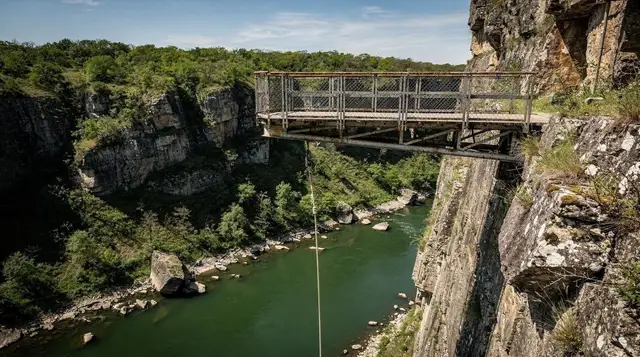
the original Kawarau Bridge jump, with the option of a river dip on the way downKawarau Bridge — 43 m, the original
This is the site to start with if you’ve never jumped before. The platform is fixed to the historic bridge, the crew work through jumpers individually rather than rushing a queue, and spectators can watch for free from the riverbank and the visitor centre — useful if you’re travelling with someone who wants no part of the jump itself. Ask for the water touch when you book if you want it; it’s not automatic.
The Ledge — 47 m, above Bob’s Peak
The Ledge launches from Bob’s Peak, reached by the Skyline Gondola above central Queenstown, which makes it the most convenient of the three if your time is tight — no drive out of town required. The platform gives you 400 m of open air below rather than a river directly under the cord, and you can choose to run, walk or go backwards off the edge. Night jumps run in season, with the town’s lights below rather than the gorge.
Nevis Bungy — 134 m, 8.5 seconds
Nevis is the one people mean when they say “the big one.” You’re driven out to the site by 4x4, about 45 minutes from central Queenstown, then walked or taken by cable car out to a pod suspended over the Nevis Canyon with no bridge or cliff edge underneath you — just the pod, the cord and open space. The free fall runs 8.5 seconds before the cord takes hold, which is long enough to register as a fall rather than an instant. The same site runs the Nevis Swing and Nevis Catapult for people who want the canyon without the ankle cord.
a combo day pairing the Kawarau Bridge bungy with a canyon swingWeight and age limits
Every jump has a weight range, checked at the site before you’re harnessed, not just asked at booking. AJ Hackett’s minimum sits around 35 kg and the maximum runs roughly 130–150 kg depending on the specific jump and equipment used — these figures are reviewed periodically, so treat them as a guide and confirm the current numbers directly when you book, not on the morning of your jump.
There’s no fixed upper age limit if you’re in reasonable health, and no strict minimum either, but anyone under about 15 needs a consenting adult present and, in most cases, a guardian’s signature. Pregnancy rules a jump out entirely. Heart conditions, high blood pressure, and recent back, neck or joint injuries are also standard exclusions — the staff will ask directly, and being straight with them is the point, not a formality to get past.
Insurance: what your policy probably doesn’t cover
This is the piece of the trip that trips people up more often than the jump does. New Zealand’s ACC (Accident Compensation Corporation) covers treatment costs for an injury sustained while you’re in the country, for visitors as well as residents — that much is genuinely reassuring. What ACC does not cover is medical evacuation or repatriation, cancellation, or any income you lose while recovering. If something goes wrong badly enough to need a flight home, ACC isn’t the safety net for that part.
Separately, and this is the part worth checking before you leave home rather than after you’ve booked: many standard travel insurance policies explicitly exclude bungy jumping, skydiving and similar activities from cover, or require a specific adventure sports add-on. A policy that looks comprehensive on the surface can still leave you unfunded for exactly this activity.
Read the policy wording, not just the summary page, and if you’re planning more than one adrenaline activity on this trip — a jump plus a skydive or a canyon swing — make sure the add-on covers the specific list, not just “adventure activities” in general. The travel insurance for adventure activities guide goes through this in more depth.
Booking and timing
All three sites take same-day bookings in quieter periods, but summer weekends and school holidays fill up, and Nevis in particular has limited capacity because of the 4x4 access. Booking a day or two ahead removes the risk of missing your preferred slot, and it lets you place the jump early in your stay — if weather rules it out on the day (wind is the main issue at Nevis and The Ledge; Kawarau is more sheltered), you want spare days left to reschedule rather than a jump booked for your last afternoon. The booking tours in Queenstown tips guide covers this pattern across activities, not just bungy.
If you’re combining a jump with other things in the gorge, Gibbston’s wineries sit a short drive from Kawarau Bridge and make a natural way to decompress afterwards — the adrenaline drops fast once you’re back on solid ground.
a private Gibbston Valley wine tour, an easy way to come down from the adrenaline afterwardsBeyond bungy: the rest of Queenstown’s adrenaline lineup
Bungy is the headline act, but it’s one of several ways Queenstown does this. The Shotover Canyon Swing is a genuinely different sensation — a 109 m arc rather than a straight drop, with around 60 m of free fall and roughly sixty different launch styles.
Skydiving over the Wakatipu basin and paragliding from Bob’s Peak are the other big-ticket options, and like bungy, both are weather-dependent enough that they’re worth booking early in your trip rather than on your last free day. If you’d rather stay closer to the ground while still getting an adrenaline hit, a full day of canyoning in the Routeburn Valley — abseiling and sliding through a river gorge rather than falling from a height — is a solid alternative.
a full day of canyoning in the Routeburn Valley as a ground-level alternative to a height jumpFor a wider view of how to sequence a jump alongside the rest of Queenstown’s adventure activities, the adrenaline-focused three-day itinerary lays out a realistic order, and the bungy and adrenaline category page lists everything currently bookable in that space. Before you fly in, it’s also worth checking the NZeTA and entry requirements guide — it has nothing to do with bungy, but it’s the kind of thing that needs sorting before you land, not after.
Bungy jumping in Queenstown: FAQ
Who opened the first commercial bungy jump, and where?
AJ Hackett opened the Kawarau Bridge site in November 1988, on the 1880 Kawarau Bridge over the Kawarau River. It was the world’s first commercial bungy jump and it’s still operating today.
What’s the difference between Kawarau, The Ledge and Nevis?
Kawarau Bridge (43 m) is a static platform jump with an optional water touch. The Ledge (47 m) launches from Bob’s Peak above Queenstown with a running or backwards start and 400 m of air below. Nevis Bungy (134 m) is New Zealand’s highest, from a pod suspended over the Nevis Canyon, with 8.5 seconds of free fall.
Is there a weight or age limit for bungy jumping in Queenstown?
Yes. AJ Hackett sets a minimum weight around 35 kg and a maximum in the region of 130–150 kg depending on the jump, and these figures are revised periodically, so confirm the current numbers when you book rather than assuming. There’s no fixed minimum age, but under-15s need a consenting adult, and pregnancy and certain heart, back or neck conditions rule the jump out.
Does travel insurance cover bungy jumping?
Often not automatically. Many standard travel insurance policies exclude bungy jumping, along with skydiving and other adventure activities, unless you’ve paid for an adventure sports add-on. New Zealand’s ACC covers treatment costs for an injury while you’re in the country, but it does not cover medical evacuation, trip cancellation or lost income, so check your policy’s wording before you jump, not after.
Can I do a bungy jump if I’m scared of heights?
Plenty of people who jump are frightened of heights — that’s largely the point. Kawarau Bridge is the gentlest introduction because the platform is close to the water and the crew talk you through it individually. Nevis, out over a 134 m canyon, is a bigger step and worth doing only once you know you can handle Kawarau or The Ledge.
How long does a bungy jump actually take?
The jump itself is seconds — Nevis gives you 8.5 seconds of free fall before the cord takes over. Budget for the whole experience, not just the drop: check-in, harnessing, the walk or gondola or 4x4 ride out, and the cord bounce afterwards. Kawarau and The Ledge can be done in under two hours including transfers; Nevis, with its remote canyon site, typically takes closer to three to four hours.
Can I get a video or photo of my jump?
Yes, all three AJ Hackett sites offer photo and video packages, usually at extra cost on top of the jump price. If proof for family back home matters to you, budget for it in advance rather than deciding on the platform, when you’ll have other things on your mind.
Bungy, swings & skydives on GetYourGuide
Verified deep-linked GetYourGuide tours. Book through these links and we earn a small commission at no cost to you.
GetYourGuide does not provide a product photo for this activity — the image shows the meeting point, photographed by us.