Nevis vs Kawarau vs the Ledge: which Queenstown bungy to jump
Which Queenstown bungy jump should I choose: Nevis, Kawarau or the Ledge?
The Kawarau Bridge is the easiest first jump and the only one with a river trempette. The Nevis Bungy is the highest and longest free fall but needs a 45-minute 4x4 transfer. The Ledge suits repeat jumpers who want a night jump close to town.
Three bungy jumps, three very different days out
Queenstown has three commercial bungy jumps within reach of town, and they’re not interchangeable. Commercial bungy itself started here: AJ Hackett opened the Kawarau Gorge site on the historic Kawarau Bridge in November 1988, the world’s first permanent commercial jump, and it’s still running. Since then the operator has added a jump from Bob’s Peak above town, known as the Ledge, and the much bigger Nevis Bungy out in a backcountry canyon.
The three differ on height, free fall time, how hard they are to reach, what the jump itself feels like, what it costs, and how easy it is to get a decent photo. This guide compares them on those points and ends with a straight recommendation depending on whether it’s your first jump, your fifth, or you’re watching the budget.
The three jumps side by side
| Kawarau Bridge | The Ledge | Nevis Bungy | |
|---|---|---|---|
| Height | 43 m | 47 m | 134 m |
| Free fall | Around 3 seconds | Longer run-up, free fall from a platform | About 8.5 seconds |
| Access from Queenstown | 25 minutes by road | 10 minutes by gondola | 45 minutes by 4x4 transfer |
| Trempette (water dip) | Yes, on request | No | No |
| Night jump | No | Yes | No |
| Spectators | Free, from the bridge and riverbank | Free, at the gondola terminal | Included at the viewing deck |
| Best for | First-timers, families watching on | Repeat jumpers, evening plans | Height chasers, longest free fall |
Height and free fall time
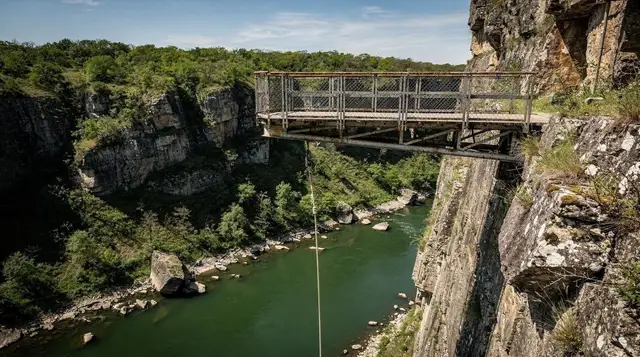
The Kawarau Bridge jump is 43 metres above the Kawarau River, off the same 1880 bridge AJ Hackett used in 1988. It’s the shortest of the three and the free fall is brief, which is exactly why it works as an introduction: there’s enough height to feel the drop properly, but the whole thing from jump to bounce is over fast.
The Ledge sits on Bob’s Peak, reached by the Skyline gondola, and is 47 metres. What makes it different isn’t the extra four metres over the Kawarau Bridge, it’s the run-up: jumpers get a free-running start off a platform rather than a straight drop from a static point, and the ground underneath is roughly 400 metres below thanks to the peak’s elevation, even though the jump itself is measured at 47 metres.
The Nevis Bungy is in a different category. At 134 metres, suspended from a cocoon-like pod slung across the Nevis Canyon, it’s roughly three times the height of the other two and delivers about 8.5 seconds of free fall before the cord engages. That’s long enough to genuinely feel the fall rather than just register it, which is the main reason people choose it over the other two.
Getting there: the Nevis is the one that needs planning
This is where the three jumps really separate. The Kawarau Bridge is a straightforward 25-minute drive from Queenstown out through the Kawarau Gorge, on a sealed road, with parking at the site. The Ledge doesn’t need a car at all: it’s the Skyline gondola up from the middle of Queenstown, a ten-minute ride.
The Nevis Bungy has no public road to it. AJ Hackett runs its own 4x4 transfers from the Queenstown base out into the Nevis Valley, a trip of around 45 minutes each way over unsealed backcountry roads that ordinary rental cars aren’t built for and aren’t insured to use. That transfer is part of the day whether jumpers like it or not: allow the better part of half a day for the Nevis once travel, check-in and the jump itself are all counted, against an hour or two for the Kawarau Bridge or well under that for the Ledge.
Anyone tight on time in Queenstown should factor that transfer in before booking, and it’s worth reading up on driving in the South Island generally, since several of the region’s best backcountry roads are off-limits to standard rental agreements.
The sensation: what each jump actually feels like
The Kawarau Bridge’s signature move is the trempette, a dip of the head and shoulders into the Kawarau River on the bounce back up, which jumpers can request before they go. It turns the jump from purely a height experience into something with a payoff at the bottom, and it’s the only one of the three where getting wet is part of the plan.
The Ledge trades water for elevation and timing. Its free-running start means jumpers sprint off the platform rather than simply stepping or falling backward, and it’s the only jump of the three that runs after dark, with the lights of Queenstown spread out below. A night jump changes the experience considerably: the drop is harder to judge by eye, which some jumpers find easier and others find more unsettling.
The Nevis is the one built around duration. Nearly nine seconds of free fall is long enough to move through fear, acceleration and then the cord engaging as distinct phases, rather than the single quick jolt of a shorter jump. The canyon setting adds to it: there’s no riverbank crowd nearby, just the pod, the cable, and open air on both sides.
Photos and video
The Kawarau Bridge is the easiest of the three to photograph well, because spectators stand for free on the bridge and riverbank, close enough to get a clear shot without paying for the operator’s package. It also helps that the jump is short, so timing a photo is more forgiving.
At the Nevis, spectators watch from an enclosed deck at the jump site rather than from alongside the pod, which puts more distance between camera and jumper. The operator sells professional photo and video packages on site, and given the transfer required to get there, most visitors buy one rather than relying on a spectator’s phone camera. The Ledge sits in between: spectators gather at the gondola terminal, close to the platform, though a night jump obviously changes what a photo can capture.
Price
Expect the Kawarau Bridge to be the least expensive of the three, reflecting its shorter transfer, lower height and simpler operation. The Ledge sits above that, and the Nevis Bungy costs more again, largely on account of the 4x4 transfer, the equipment for a 134-metre jump, and the half-day it occupies. All three operators bundle combo options, pairing a bungy with the Nevis Swing or Nevis Catapult at the same site, or with the Kawarau’s swing, which can work out better value than booking jumps separately if more than one activity is on the list. For a Nevis day that combines the jump with the swing in one visit:
book the Nevis Bungy and swing comboFor those who’d rather start at the original bridge and add its swing to the same outing:
book the Kawarau Bridge bungy and swing comboFor a Kawarau visit built around the swing rather than the bungy, with a choice of solo, tandem or triple jump:
book the Kawarau swing, solo, tandem or tripleWhich one to choose
First jump, no prior experience: the Kawarau Bridge. It’s the shortest transfer, the lowest height, the option to add the trempette, and free spectator viewing for anyone along for the ride but not jumping. It’s also the historic site, which for some first-timers is part of the appeal.
Already jumped before and want more: the Nevis Bungy. The height and near nine-second free fall are a genuine step up from either of the other two, and the transfer, while a commitment, is part of what makes the day feel like an event rather than a quick stop. Pairing it with the Nevis Swing or Nevis Catapult at the same site makes sense for anyone making the trip out anyway:
book the Nevis Swing and Catapult comboTight on time or budget, or want a jump in the evening: the Ledge. No separate transfer beyond the gondola already worth riding for the view, a shorter time commitment than the Nevis, and the only one of the three with a night option for anyone wanting to end the day on Bob’s Peak after dinner in town.
Travelling with people who won’t jump: the Kawarau Bridge again, since it’s the only site where non-jumpers get a genuinely good, free view of the action from the bridge and riverbank rather than a paid viewing platform.
For a broader look at booking any of these, including how far ahead to lock in a slot in Queenstown, or the wider case for and against bungy jumping at all three sites, the bungy jumping guide covers the basics this comparison assumes. Anyone weighing a canyon swing instead of, or alongside, a bungy should also read the Shotover Canyon Swing guide, which is a different kind of drop again, with roughly 60 metres of free fall inside a longer arcing swing.
Safety, cancellations and insurance
All three jumps run on the same underlying safety system AJ Hackett has operated since 1988, with weight limits, harness checks and staff at every stage. None of the three should be treated as risk-free simply because the operator is long established.
New Zealand’s ACC scheme covers the cost of medical treatment following an accident for everyone in the country, visitors included, but it does not cover repatriation, trip cancellation or lost income, and a fair number of standard travel insurance policies specifically exclude bungy jumping and similar adventure activities. It’s worth reading the policy wording, not just the marketing page, before booking, and the travel insurance for adventure activities guide goes through what to look for.
Weather can also cancel or delay any of the three, most often high wind at the Nevis given its exposed canyon setting. Building a jump into the first half of a Queenstown trip rather than the last day leaves room to rebook if needed, an approach that also suits a dedicated adrenaline-focused three days built around bungy, jet boating and rafting rather than squeezing one jump into a single afternoon. For a first-hand account of what the nerves and the drop actually feel like from the original bridge, it’s worth reading one visitor’s account of jumping the Kawarau Bridge before booking.
And since Queenstown’s prices, including bungy, sit at the higher end of what New Zealand charges for anything, it’s fair to go in with eyes open on cost, which this look at why Queenstown is so expensive lays out plainly, alongside more general tips for keeping a Queenstown trip on budget and, for anyone determined to capture the moment properly, where to find good vantage points for photos around town before or after the jump itself, and how car hire terms interact with backcountry access more broadly in the Queenstown car rental guide.
Which Queenstown bungy jump
Which is the highest bungy jump in Queenstown?
The Nevis Bungy, at 134 metres above the Nevis River, with about 8.5 seconds of free fall. The Ledge is 47 metres and the Kawarau Bridge is 43 metres.
Can you get wet on the Kawarau Bridge bungy?
Yes. The Kawarau Bridge is the only one of the three where jumpers can request a trempette, a dip of the head and shoulders into the Kawarau River at the bottom of the jump.
How do you get to the Nevis Bungy site?
There’s no public road. AJ Hackett runs 4x4 transfers from its Queenstown base into the Nevis Valley, a trip of around 45 minutes each way over unsealed backcountry roads.
Can you bungy jump at night in Queenstown?
The Ledge, on Bob’s Peak above town, offers night jumps. Neither the Kawarau Bridge nor the Nevis Bungy runs after dark.
Does travel insurance cover bungy jumping in Queenstown?
Not always. Many standard travel insurance policies exclude bungy jumping and other adventure activities, so check the policy wording before booking. New Zealand’s ACC scheme covers accident-related medical treatment for visitors, but not repatriation, cancellation or loss of income.
Which Queenstown bungy is cheapest?
The Kawarau Bridge is generally the least expensive of the three, reflecting its shorter transfer and lower height. The Nevis Bungy costs more, largely because of the 4x4 transfer and equipment needed for a 134-metre jump.
Is the Nevis Bungy or the Kawarau Bridge better for photos?
The Kawarau Bridge gives spectators a free, close-up view from the bridge and riverbank, so photos and video of a jumper are easy to get. At the Nevis, spectators watch from an enclosed viewing deck at the site, further from the action, though the operator sells professional photo and video packages there too.
Can beginners do the Nevis Bungy as their first jump?
Yes, no experience is required for any of the three jumps. First-timers do choose the Nevis regularly, but the longer transfer, greater height and 8.5-second free fall make it a bigger commitment than the Kawarau Bridge for a first attempt.
Bungy, swings & skydives on GetYourGuide
Verified deep-linked GetYourGuide tours. Book through these links and we earn a small commission at no cost to you.
GetYourGuide does not provide a product photo for this activity — the image shows the meeting point, photographed by us.