South Island vs North Island: which one for your first New Zealand trip?
Should a first trip to New Zealand go to the South Island or the North Island?
Most first-time visitors get more out of the South Island for scenery and outdoor activity, and the North Island for Māori culture, geothermal landscapes and the two biggest cities. With two to three weeks, doing both is realistic; with one week, pick one island rather than rushing across both.
Two islands, one country, very different trips
New Zealand is often talked about as a single destination, but the North Island and South Island offer genuinely different holidays. They are separated by the Cook Strait, roughly a three-hour ferry crossing or a short flight, and each has its own weather patterns, its own dominant landscapes and its own balance of culture versus scenery. Neither island is the “real” New Zealand and the other a lesser version of it. This guide compares them honestly, on the points that actually change a trip, and explains where Queenstown fits into a national itinerary rather than pretending it is the only place worth going.
The short version: the South Island wins on raw scale of scenery — mountains, glaciers, fjords, and the alpine lakes around Queenstown and Wanaka. The North Island wins on geothermal landscapes, the deepest and most accessible Māori cultural experiences, and the country’s two largest cities, Auckland and Wellington. Rotorua, the Bay of Islands and the volcanic plateau are genuinely worth a visitor’s time and are outside the scope of a Queenstown-based site, but they deserve an honest mention rather than a dismissal.
Landscape and scale
The South Island is where New Zealand’s postcard mountains live. The Southern Alps run almost the length of the island, with Aoraki / Mount Cook at 3,724 metres the highest peak in the country. Glaciers descend close to sea level at Franz Josef and Fox, something that does not happen anywhere in the North Island.
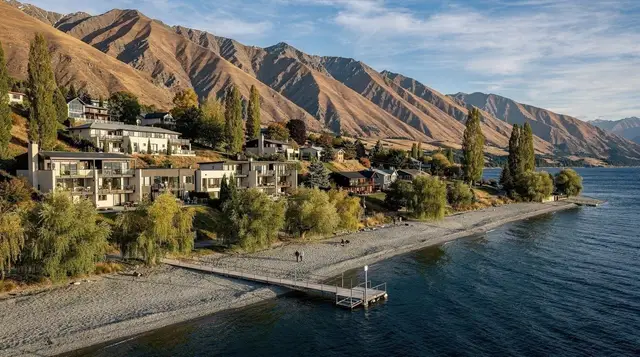
Fiordland, reached from Queenstown via Te Anau, holds Milford Sound and Doubtful Sound, carved by glaciers into cliffs that rise more than a kilometre straight out of the water. Add the braided rivers of the Mackenzie Basin, the turquoise lakes fed by glacial flour, and the beech forest of the Catlins, and the South Island reads as one long sequence of scenic set pieces.
The North Island’s landscape story is different, not smaller. It sits on the boundary of the Pacific and Australian tectonic plates, which gives it active geothermal fields around Rotorua and Taupō — geysers, mud pools and hot springs that the South Island simply does not have. Its volcanic peaks, including Tongariro and Ruapehu, form a different kind of alpine scenery, and its coastline, from the Bay of Islands to the Coromandel Peninsula, runs to subtropical beaches rather than fjords.
Comparing the two on “which is more beautiful” misses the point: they are different geological stories, and a visitor drawn to jagged snow-capped ranges and deep-water fjords will get more from the South Island, while a visitor drawn to geothermal activity and volcanic cones will get more from the North.
Māori culture and history
This is the category where the North Island has a clear, honest edge, and it is worth saying plainly rather than glossing over. The Bay of Islands is where the Treaty of Waitangi was signed in 1840, and Waitangi remains the country’s most significant site for understanding that history. Rotorua has the country’s densest concentration of accessible Māori cultural experiences — marae visits, cultural performances, hāngī and guided storytelling built around generations of iwi in the region. A visitor who wants a first, substantial introduction to Māori culture and history will do better spending time in the North Island than trying to compress it into a South Island itinerary.
That does not mean the South Island has no Māori presence. Ngāi Tahu is the principal iwi of most of the South Island and holds deep connections to places covered elsewhere on this site, including the naming of Queenstown itself as Tāhuna and Lake Wakatipu’s traditional association with the giant Matau. Place names throughout Otago and Fiordland, including Piopiotahi for Milford Sound, carry this history, and it is worth learning rather than skipping past. But the scale of visible, bookable cultural experience is smaller in the south, concentrated in specific places rather than spread across a whole region the way it is around Rotorua.
Adventure and outdoor activities
Here the balance tips firmly south, and it is the reason Queenstown built its reputation. Commercial bungy jumping was invented at the Kawarau Bridge in 1988 and the region around Queenstown remains the country’s concentrated centre for adrenaline activities — jet boating on the Shotover and Kawarau rivers, whitewater rafting, skydiving over the Wakatipu basin, and canyon swinging. The South Island also holds the country’s most demanding Great Walks, including the Milford Track and the Routeburn, and four ski fields within reach of Queenstown and Wanaka that operate through winter.
The North Island has its own outdoor scene — surfing on the west coast, mountain biking around Rotorua’s purpose-built trail network, and hiking on Tongariro — and it should not be written off. But the sheer density and variety of high-adrenaline, alpine and glacial activity within a couple of hours of one town is a South Island phenomenon, and Queenstown specifically. A traveller whose trip is built around adventure sports will get more return on their time in the south.
For a South Island loop that covers this ground properly rather than skimming it, a multi-day tour is often more efficient than self-driving every leg: the 5-day South Island tour from Dunedin to Christchurch strings together several of the region’s landscape highlights without the logistics of arranging each leg separately, and travellers wanting to add Stewart Island without extending their own itinerary planning can look at the 6-day South Island tour covering Stewart Island and Fiordland.
Distances and getting around
Distances work differently on each island. The North Island is more compact: Auckland to Wellington is around 640 kilometres, and Rotorua sits roughly in the middle, making a loop through the main North Island highlights achievable in under a week without long driving days. The South Island is more spread out relative to its attractions.
From Queenstown, Dunedin is 280 kilometres, Milford Sound is 288 kilometres by road (about four hours), and Franz Josef on the West Coast is 350 kilometres, around five and a half hours via Wanaka and the Haast Pass. See queenstown to Christchurch routes for the options between the South Island’s two main gateway cities, which run 480 kilometres and six to eight hours depending on the route chosen.
Crossing between the islands means the Cook Strait, either the vehicle ferry between Wellington and Picton (roughly three to three and a half hours, subject to weather) or a domestic flight. A rental car does not usually cross with you unless you specifically book an inter-island vehicle transfer, so most itineraries that cover both islands arrange separate hire cars on each side.
Climate and seasons
Both islands run on the same hemisphere-reversed calendar as the rest of New Zealand: summer from December to February, winter from June to August. But the two islands do not experience seasons identically. The South Island’s climate swings harder — Queenstown’s winters bring genuine snow and ski conditions, while its summers get properly hot in the low-elevation basins. The North Island, further from the pole and lacking the same scale of high mountains, has a milder, more subtropical range overall, particularly in Northland and the Bay of Islands, and its winters rarely bring the same cold.
Rainfall varies enormously within each island rather than by island alone. On the South Island side, Queenstown sees around 900 millimetres a year while Milford Sound, only four hours away, gets close to ten times that. There is no single number that describes South Island weather, and the same caution applies to the North Island’s own regional differences between the geothermal plateau and the coast. See best time to visit Queenstown for how this plays out specifically around the South Island’s most visited town, and queenstown in winter for what a southern winter actually involves.
Cost
Neither island is a budget destination by international standards, but there is a real cost gradient worth knowing about before booking. Queenstown and the Milford Sound corridor are consistently the most expensive pocket of the entire country — accommodation, activities and food all run higher here than almost anywhere else in New Zealand, a point covered in more detail in why Queenstown is so expensive. Christchurch and most North Island cities, including Auckland and Wellington outside peak events, tend to sit a notch below Queenstown for comparable accommodation. Rotorua and smaller North Island towns are generally more moderate again.
This does not mean skip the South Island to save money — its landscapes and activities are difficult to substitute — but it does mean budgeting realistically. A rough per-person daily range, accommodation and food only, before activities:
| Region | Budget (NZD/day) | Mid-range (NZD/day) |
|---|---|---|
| Queenstown / Milford corridor | 120–180 | 250–400+ |
| Christchurch / South Island regional towns | 90–140 | 180–280 |
| Auckland / Wellington | 100–150 | 200–320 |
| Rotorua / North Island regional towns | 80–120 | 160–250 |
Activity costs add up separately and quickly in Queenstown specifically, since adventure sports here run from roughly NZD 150 for a shorter jet boat trip to over NZD 700 for a day combining a Milford Sound cruise with a scenic flight back. See what a day in Queenstown really costs for a line-by-line breakdown.
Where Queenstown fits in a national circuit
If a trip is built around the South Island specifically, Queenstown works well as a base for four to seven nights, from which Milford Sound, Wanaka, Arrowtown, Aoraki / Mount Cook and the adventure activities are all within day-trip or short-tour range. Multi-day tours departing the region can also fold in destinations further south that are awkward to self-drive on a tight schedule, such as the 5-day, 4-night Southern Highlights tour from Queenstown, which covers a wider southern loop without requiring the traveller to plan each overnight stop themselves.
For visitors adding Stewart Island to a South Island itinerary — genuinely one of the few places in the country to see a wild kiwi — the logistics from Queenstown normally mean either a long overland run to Bluff for the ferry or a scenic flight connection; the day trip to Stewart Island via scenic flight from Queenstown is built specifically to make that addition realistic within a South Island loop rather than needing its own extra days.
If a trip is a genuine national circuit covering both islands, the honest sequencing question is usually about time rather than preference: with seven to ten days total, most visitors do better giving the whole allocation to one island rather than splitting it and spending disproportionate time in transit. With two weeks or more, a loop that takes in Auckland or Wellington, Rotorua, and then flies or ferries south to Christchurch or Queenstown is a well-worn and sensible route.
See how many days in Queenstown and south island vs north island planning notes for the practical side of building that out, and nzeta and entry requirements for what needs sorting before any of it, regardless of which island comes first.
Making the call
Neither island is the wrong choice, and neither needs the other talked down to make its own case. A traveller who wants alpine scenery, glaciers, fjords and a dense cluster of adventure activities within a short drive of one town should lean South Island and base themselves around Queenstown or Wanaka. A traveller whose priority is Māori cultural experience, geothermal landscapes and New Zealand’s two biggest cities should lean North Island and spend their time around Auckland, Rotorua and Wellington. With enough time, seeing both properly, rather than skimming both quickly, is the version of the trip most visitors come away glad they took.
For those set on the South Island and wanting a structured way to see its Otago and Fiordland highlights without piecing together transport themselves, the 5-day South Island private tour from Queenstown is worth comparing against a self-drive itinerary on cost and time before deciding which suits the trip better.
Frequently asked questions about choosing between the islands
Can I do both islands in one trip?
Yes, with enough time. Two weeks lets you cover one island properly and skim the other; three weeks or more allows a fuller loop of both without constant packing and driving.
Do I need the inter-island ferry, or should I fly?
The Cook Strait ferry between Wellington and Picton carries vehicles and takes roughly three to three and a half hours, weather permitting. Flying between the islands is faster and often cheaper if you are not bringing a rental car across, but you will need to arrange separate hire cars on each island.
Is the South Island really more scenic than the North Island?
The South Island has the higher mountains, the larger glaciers and the fjords, which is why it dominates postcards. The North Island has its own landscapes, including geothermal fields and volcanic peaks, that the South Island does not have at all.
Where is Māori culture strongest in New Zealand?
The North Island, particularly Rotorua and the Bay of Islands, has the country’s largest concentration of Māori cultural experiences, marae visits and historical sites tied to the Treaty of Waitangi. The South Island’s Ngāi Tahu heritage is real but far less visible to a short-stay visitor.
Is Queenstown on the South Island or the North Island?
Queenstown is on the South Island, in Otago, about 4 hours by road from Milford Sound and roughly 6 to 8 hours by road from Christchurch, the South Island’s main gateway city.
Which island is cheaper to visit?
Neither island is cheap by New Zealand standards, but Queenstown and the Milford Sound corridor are consistently the most expensive pocket of the country. Smaller North Island towns and Christchurch tend to run a little lower than Queenstown for accommodation and activities.
Do I need a car on both islands?
A car or a well-planned combination of buses and shuttles works on both, but distances and driving conditions differ. South Island roads through places like the Crown Range or Milford Road demand more caution, chains in winter, and realistic time buffers.
Popular Queenstown experiences on GetYourGuide
Verified deep-linked GetYourGuide tours. Book through these links and we earn a small commission at no cost to you.
GetYourGuide does not provide a product photo for this activity — the image shows the meeting point, photographed by us.