What an alpine or glacier landing actually involves
How long do you actually spend on the snow during an alpine or glacier landing?
Most alpine and glacier helicopter landings give you 5 to 15 minutes on the ground, split across one or two landing sites. The flight itself runs 20 to 50 minutes depending on the operator, but the walking-on-snow part is short — plan photos accordingly and don't expect a hike.
Why book a landing at all
A scenic flight without a landing shows you the same mountains through a window. A flight with a landing puts you on the snow for a few minutes, engine idling or shut down, in air that’s often 10 to 20 degrees colder than wherever you took off from. That’s the entire pitch, and it’s worth being precise about it before paying several hundred dollars: you are not hiking, you are not staying overnight, and you are not landing on the summit of anything. You’re being set down on an approved patch of snow or ice for long enough to look around, take photos, and get back in.
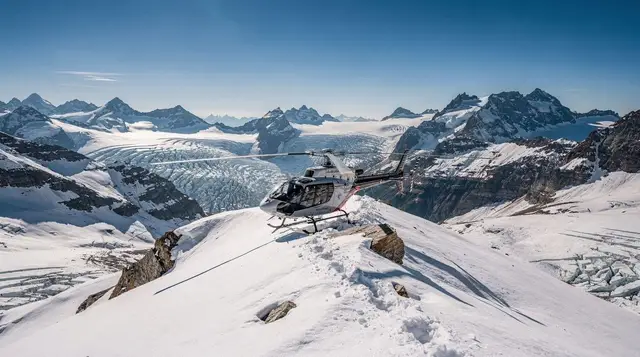
Operators flying out of Queenstown, Wanaka, Glenorchy, Franz Josef and Milford Sound all sell some version of this. The marketing photography — a helicopter parked on a blindingly white ridge under a blue sky — is real, but it’s also the best five minutes of a much longer day, and the brochure rarely mentions how few minutes that actually is. This guide covers what to expect on the ground, what to wear, why the site you land on may not be the one advertised, and how the seasonal-snow landings around Aoraki / Mount Cook differ from the glacier landings out of Franz Josef and Fox Glacier.
Ground time: the number nobody puts on the ad
Expect 5 to 15 minutes on the ground per landing site. A single-landing flight might give you 10 minutes standing on snow; a two-landing itinerary — common on the longer Franz Josef and Milford Sound routes — splits that across two stops, so each one can be shorter again. The rest of a 30 to 50 minute booking is flight time: climbing out over the valley, crossing ridgelines, circling for the approach, and the return leg.
This matters because people book these flights expecting a snow experience on the scale of the flight time, and it isn’t that. If you’re paying for 45 minutes in the air and get 12 minutes total on the ground, that’s normal, not a shortchange. Ask the operator directly how many landings are included and roughly how long each one runs before you book — most will tell you honestly, and the honest answer is short.
What you can realistically do in that window: step out, take photos of yourself and the group, look at the view, maybe throw a snowball if there’s enough snow and the pilot doesn’t mind. You cannot wander far — pilots keep passengers close to the aircraft, partly for safety around a running rotor and partly because crevasses can be nearby even on sites that look flat. Bathroom breaks aren’t part of the plan; go before you fly.
Altitude and what that means for you
Landing sites for these flights typically sit between 1,500 and 2,500 metres, depending on the operator and route. Aoraki / Mount Cook itself reaches 3,724 metres, but passenger landings happen well below the summit, on stable snowfields and saddles the operators have scouted and cleared for repeated use — not on exposed ridgelines or near crevassed icefalls.
At that altitude the air is noticeably thinner and colder than at Queenstown or Wanaka, both of which sit under 500 metres. Most people don’t notice altitude effects at 2,000 metres for a 10-minute stop, but the temperature drop is real and immediate: wind chill on an exposed alpine landing site can make a mild valley day feel properly cold. Sun exposure is also stronger at altitude and off snow glare — sunglasses matter even on an overcast day.
Seasonal snow versus permanent névé
This distinction gets glossed over in most marketing, and it’s worth understanding because it changes what you’re actually standing on.
Seasonal snow is what falls each winter and largely melts away by the following summer, or compacts into old snow that doesn’t survive more than a year or two. Many of the landings around Mount Cook, the Tasman valley approaches, and the high country near Lake Tekapo are on this kind of snowfield — beautiful, stable enough for a helicopter skid, but not part of a moving glacier.
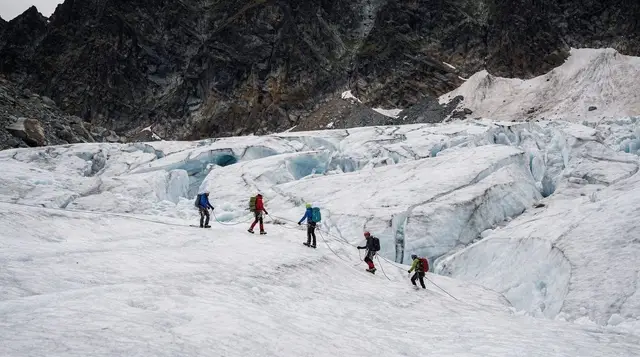
Névé is different: it’s snow that has survived at least one summer without fully melting, compacted under its own weight, and it’s the transitional layer that eventually becomes glacial ice further down the mountain. Landings on the upper névé of the Franz Josef and Fox Glacier systems put you on the accumulation zone of an actual moving glacier — the same ice body that, further down the valley, calves into the crevassed icefall visible from the valley floor. Since 2012, walking onto either glacier from the valley floor hasn’t been permitted at all; a helicopter landing on the upper névé is the only way most visitors get onto the ice.
Neither kind of landing is “better” outright. A Mount Cook alpine landing gives you scale and drama — the highest peak in the country, ridgelines running off in every direction. A Franz Josef or Fox Glacier landing gives you the texture of an actual glacier: crevasses, blue ice, seracs, visible from a safe distance rather than underfoot. If glacial ice specifically is the point of the trip, book a Franz Josef or Fox Glacier flight, not a Mount Cook one — read the operator’s route description carefully, because “alpine landing” and “glacier landing” get used loosely.
What to wear
Bring warm layers regardless of what the weather is doing at sea level. A windproof outer shell, a warm mid-layer, gloves, and something that covers your ears cost nothing to carry and make a real difference in the 5 to 15 minutes you’re standing in rotor wash on snow. Closed, sturdy shoes are worth having — trainers are fine, but anything open-toed is a bad idea on ice and compacted snow, and most operators will simply say no at the pad.
Sunglasses and sunscreen matter more than people expect, because reflected UV off snow at altitude is intense even under cloud. If you wear glasses, a strap helps — losing a pair to rotor wash on a glacier landing site is a real and recurring problem for operators, and you won’t be getting it back.
Most helicopter operators don’t supply cold-weather gear beyond, occasionally, a blanket in the cabin. Check your specific booking’s inclusions before assuming boots or jackets are provided — for Mount Cook and Milford Sound landings in particular, dress as though you’re the one responsible for staying warm, because you are.
Why the pilot changes the site without warning
Every operator holds a set of approved landing sites along each route, not a single fixed spot. The pilot picks on the day, sometimes in the air, based on wind direction and strength at altitude (which can differ sharply from conditions at the departure pad), cloud base, recent snowfall or melt changing surface stability, and whether another aircraft is already using the planned site. On glacier routes specifically, crevasses shift the terrain from one week to the next, so a site used last month may no longer be judged safe.
None of this is announced in advance because it can’t be — conditions at 2,000 metres are assessed close to the moment of landing, not the night before. If your flight lands somewhere different from the marketing photo, that’s the system working as intended, not a downgrade. The view from most approved sites along a given route is broadly comparable; the specific ridge or saddle matters far less than people expect once they’re standing on it.
Weather, cancellations and rebooking
Alpine and glacier landing flights are cancelled more often than most visitors anticipate, and more often than sightseeing flights that don’t involve a landing — a safe touchdown needs calmer wind and better visibility than a flyover does. Cloud sitting on the tops, an approaching front, or wind at altitude can ground a flight on a day that looks clear and calm from town.
Book this early in your trip, not on your last available day. Reputable operators offer a full refund or free rebooking for weather cancellations — confirm the specific policy before paying, since terms vary. If your schedule only allows one shot at it, build in a spare day if you can, particularly around Milford Sound and Fiordland, where weather turns faster and more often than in the Mackenzie Basin.
Travel insurance is worth checking closely here. ACC (Accident Compensation Corporation) covers accident-related medical treatment for everyone in New Zealand, visitors included, but it doesn’t cover cancellation costs, rebooking fees, or lost time. Separately, many travel insurance policies exclude helicopter landings on snow or ice under their adventure activities clause — read the policy wording rather than assuming a general “adventure sports” add-on covers it. See our guide to travel insurance for adventure activities before booking anything that depends on being covered.
Comparing the main landing routes
| Route | Typical flight length | Ground time | What you land on | Typical price range (NZD) |
|---|---|---|---|---|
| Mount Cook alpine landing | 30–45 min | 10–15 min, one site | Seasonal snowfield | 450–650 |
| Franz Josef glacier landing | 20–30 min | 10–15 min, one site | Glacial névé | 400–550 |
| Franz Josef 4-glacier, two landings | 40–50 min | 20–25 min total, two sites | Glacial névé | 650–900 |
| Milford Sound flight with landing | 40–60 min | 10–15 min, one site | Alpine snowfield near Milford | 600–900 |
| Glenorchy alpine lakes landing | 25–35 min | 10 min, one site | Alpine tussock and snow, seasonal | 350–500 |
Prices vary by season, operator, and departure point, and these ranges are indicative rather than fixed — always check the current quote for your dates.
For a straightforward alpine landing with the shortest travel time from Queenstown itself, the Mount Cook helicopter flight with an alpine landing is a common first choice. If glacial ice specifically is the goal, the Franz Josef glacier helicopter flight with a landing puts you on the névé itself, and the four-glacier helicopter ride with two landings covers more ground for a longer flight and two separate stops.
Travellers based near Glenorchy sometimes prefer the shorter, cheaper Glenorchy glacier explorer flight with landings, and anyone already booking a Milford Sound day includes an alpine stop by combining it with the Milford Sound helicopter flight with a glacier landing.
Where these flights depart from
Departure points shape both the price and the scenery on the way in. Flights over Aoraki / Mount Cook generally depart from Mount Cook Village, Twizel, or Lake Tekapo, putting the country’s highest peak and the Tasman Glacier within a short flight. Flights to the Franz Josef and Fox Glacier névé depart from the West Coast towns themselves, which means either a long drive over the Haast Pass first or a fly-in package from Queenstown.
Glenorchy departures are the closest to Queenstown by road and give an alpine lakes and Fiordland-edge landing without the longer transfer. Milford Sound landings usually run as an add-on to a fly-in, cruise, fly-out day, replacing part of the long road transfer with a flight and stacking a landing into the same day.
None of these are interchangeable for planning purposes — a Mount Cook landing booked from Queenstown adds a road trip either side, while a Glenorchy landing can be a half-day out and back. Check the best hikes and day trips and how many days in Queenstown guides if you’re trying to fit a landing flight around everything else on the list, and don’t schedule one for your last morning before a flight home — cancellations and rebooking need slack you won’t have.
The realistic version
An alpine or glacier landing is genuinely one of the more memorable things on offer around Queenstown, Wanaka and the West Coast, and the photos are not exaggerated. What’s worth correcting before you book is the scale: a short, cold, spectacular few minutes on the snow, bracketed by a flight that’s often longer than the landing itself, subject to weather that can cancel it outright, and landed wherever the pilot judges safest on the day rather than wherever the brochure photo was taken. Book it, dress for it properly, and don’t build your only free day around it.
Glacier heli-hikes & flights on GetYourGuide
Verified deep-linked GetYourGuide tours. Book through these links and we earn a small commission at no cost to you.
GetYourGuide does not provide a product photo for this activity — the image shows the meeting point, photographed by us.